Freedom of the Marvelous
Caught on an emotional precipice between the irretrievable and the unhoped for, men and women today rarely recognize each other, or even themselves. Ask them who they are, what they are doing, where they are going; they stare blankly, stammer, look the other way. No one dares be happy: too many wars, too many suicides, too many unemployed, too many priests, too many cops; too many "troubles" of every sort conceivable and too many that are scarcely conceivable at all. The exceptions prove the rule. The traffic is always heavy, the weather is always bad. No doubt about it: Life today is only five per cent of life, and day by day the percentage goes down.
Stand for twenty minutes on any street corner of any large city, and note the expressions in the eyes of the multitude of far from perfect strangers who pass by with nothing better to do, it seems, than to perfect their estrangement. At such moments people have been known to ask themselves: Is this why I was born? Is this all? They ask themselves, I say; for if they were to ask those questions of others they would find themselves placed under arrest, or carted away for electroshock, or provided with still further examples of the consequences of exercising the right of free speech.
It is nonetheless true that this discomfort, this despair that gnaws through the darkness in everyone's heart, endlessly opens loopholes in the wall of logic used to justify the universal immobilization of the human spirit. Through these loopholes, while they last, the flame of freedom faintly glimmers, illuminating the promise that something else exists or could exist. For most people this flame flickers its last, or almost its last, in a protracted form of death known as "maturation." Every hope is extinguished as fast as it appears, accompanied by rituals of submissive evasion that reinforce the cheap mysticism of everyday life. Imagination, dream, fantasy, play, adventure-everything that gives life a hint of magic and exaltation is relegated to an increasingly depreciated childhood. Civilization is founded on the murder of children because it is childhood, as André Breton suggested, that "comes closest to true life."
There remain, for most people, only a few rare "unconnected" and "inexplicable" moments: fleeting eruptions of inspiration, sudden passions, dazzling encounters "by chance." Such moments, true glimpses of the Marvelous, secure themselves permanently in each person's psychic life, in the depths of each person's inner mythology. Shunned by repressive reason, persecuted by routine, these magic moments nonetheless remain secret signposts for the wandering mind-for the shadow in search of its substance.
To extend these moments, to unite them, to hasten their proliferation, to arm them, as it were-such have always been central functions of poetry. With the formation of the surrealist movement the poetic effort has attained its highest stage of development. What had been only individual, sporadic, unconscious-and therefore easily defeated-with surrealism becomes collective, systematic, conscious, invincible.
To overcome the contradiction between these marvelous moments and the everyday, to actualize the Marvelous in everyday life — that is the surrealist project.
First, last and always, surrealism is a revolutionary movement. Its first periodical, published by the first surrealist group in France from 1924 to 1929, was titled The Surrealist Revolution. Beginning on "idealistic" ground, but recapitulating the whole course of modern western philosophy in a few months, the surrealists found their own orientation and their aspirations verified and developed by the historical materialism of Marx and Engels, which itself received an astonishing verification and development from the October Revolution in Russia, 1917.
Perceiving that the contradiction between the limitless capacities of the mind and the misery of everyday life corresponds to the contradiction between the productive forces and the bourgeois relations of production-which in turn is the basis of the irreconcilable antagonism between proletariat and bourgeoisie-the surrealists entered the revolutionary workers' movement. The French group's second journal (1930-33) was called Surrealism in the Service of the Revolution-the change being tactical rather than one of principle; for the communist revolution, in the service of which the surrealists enlisted themselves, is itself, from the surrealist point of view, in the service of surrealism. Communist revolution, which alone can provide each individual with "the means of cultivating his gifts in all directions," as Marx wrote in The German Ideology, sets the stage for the fullest development of surrealism, the realization of Lautréamont's maxim: "Poetry must be made by all."
Beginning with the abolition of imaginative slavery and a thoroughgoing revaluation of all values, surrealism requires the definitive overthrow of the bourgeois/christian order and the elaboration, on communist foundations, of a non-repressive civilization governed by the watchword: To each according to his desire.
It hardly needs to be stressed how little all this has to do with "art." Between the imperialists' first world massacre and their second, it is true, surrealism maintained a virtually uncontested hegemony over the plastic arts. This "coincidence" has misled many into believing that surrealism was itself reducible to an "artistic" movement. From this mistake flow many others: for example, the appearance of "pop" and "conceptual" art, and other well-publicized "avant-gardes," are offered as "proof" that surrealism has grown "obsolete."
It is appropriate, on the occasion of the World Surrealist Exhibition, to serve notice that the surrealists are less willing today than ever to renounce Jacques Vaché's exemplary declaration, that "We know neither Art nor Artists." It is worth noting that not one of the nineteen in the original surrealist group was a painter; that in the first Surrealist Manifesto painting was mentioned only in a footnote; that even in Breton's Surrealism in Painting-surely the most important work on the plastic arts in this century-painting is designated as a "lamentable expedient."
Just as Marx's theory of communism is a critique and supersession of philosophy and political economy, so surrealism is a critique and supersession of literature and art. If, since Marx, academic disciplines known as philosophy and economics have continued to exist, they have been almost without exception mere scholastic justifications of bourgeois rule. Similarly, after the consolidation of surrealism, "art" as such has continued as a decoration and diversion for the degenerating bourgeoisie, whereas surrealism has pursued its researches altogether outside all "specialized," alienated, exploitative, reified categories. Surrealism marks the end of esthetics because esthetics is only another obstacle to the elaboration of a new, revolutionary poetic way of life.
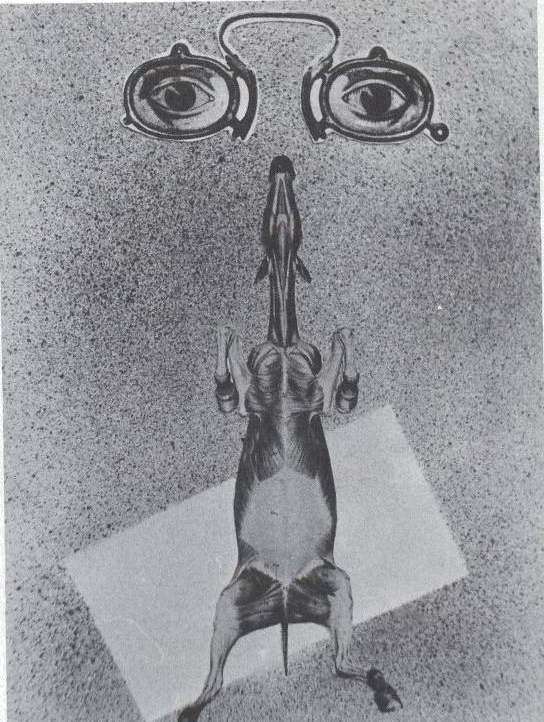
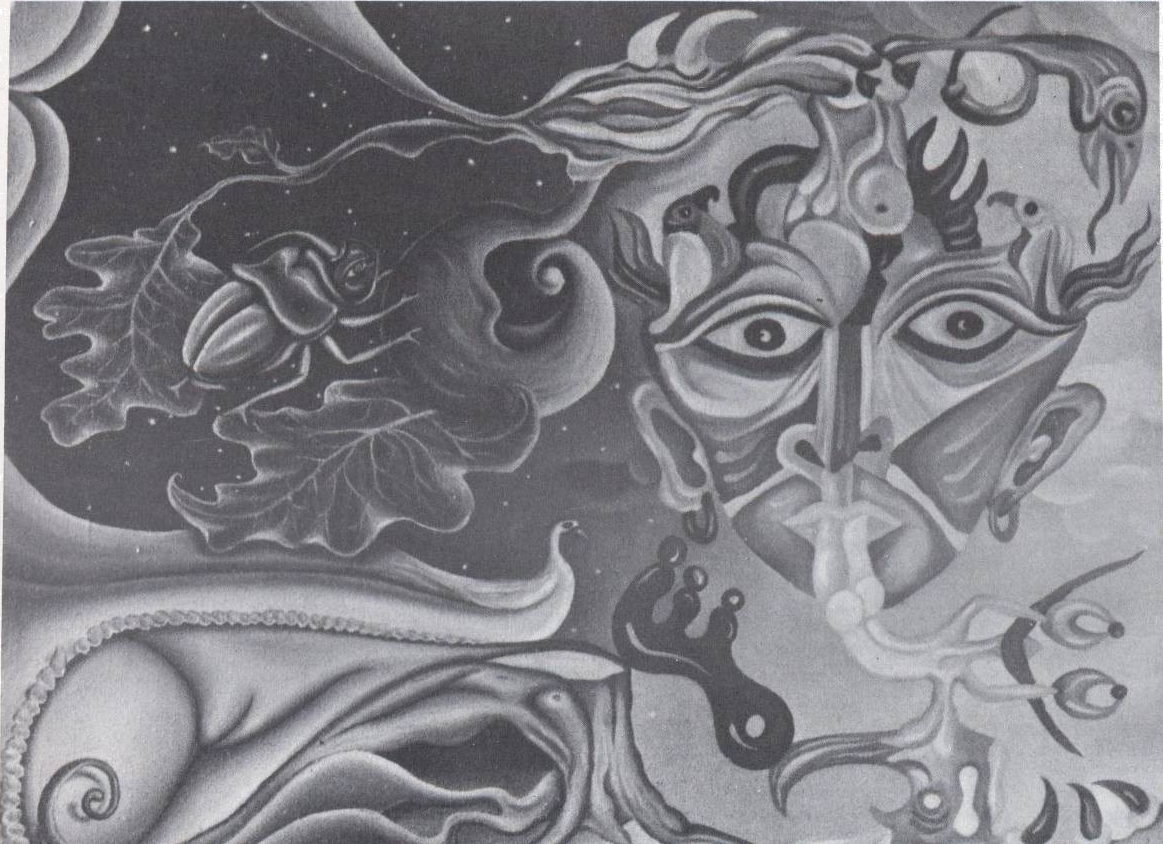
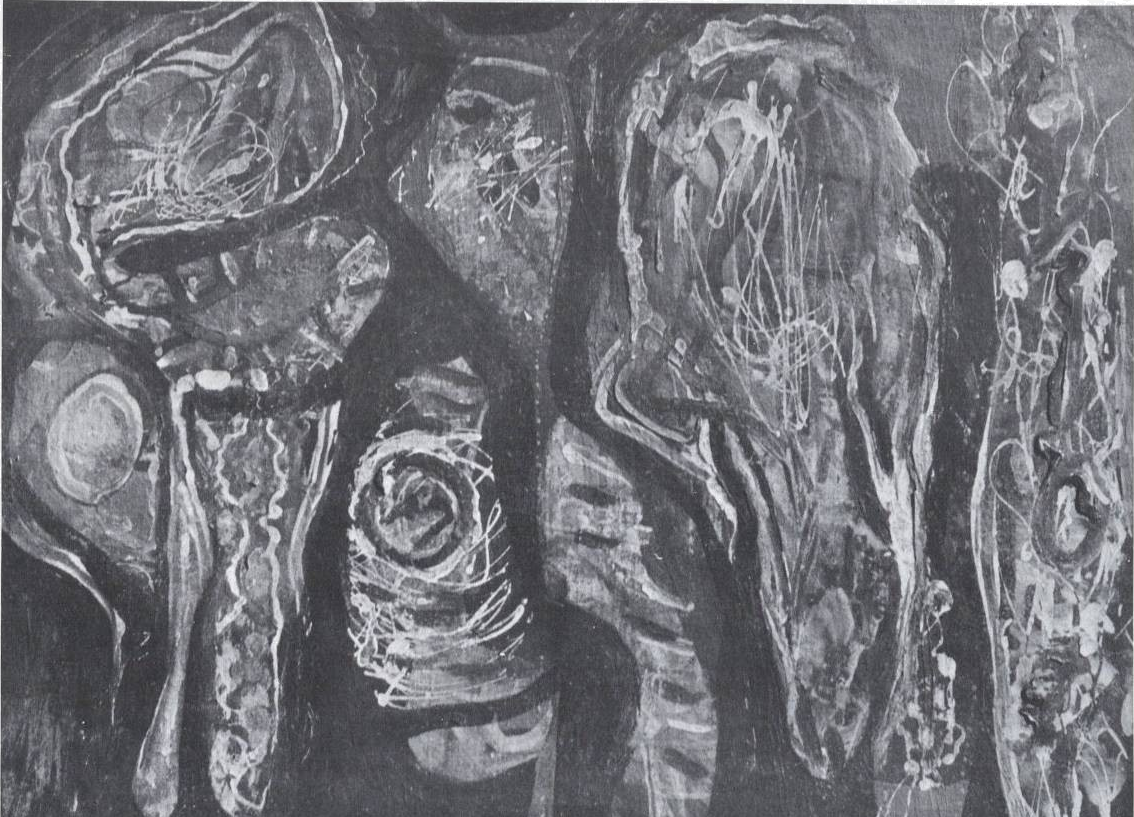
To be sure, there are those who prefigure and prepare this surrealist way of life by means of painting, drawing, photography, or by rearranging images clipped from magazines, or by assembling objects found in the street, or by chipping away at blocks of stone. To present some of the surrealist evidence achieved by these means is one of the reasons we have organized the World Surrealist Exhibition. What deserves emphasis, however, is that the works presented here were realized without any artistic pretext. To view them in an esthetic light would be to miss the point completely. Since the founding of surrealism, the only true artists (with few exceptions) have ceased to think of themselves as artists; they have been less interested in changing art than in changing life.
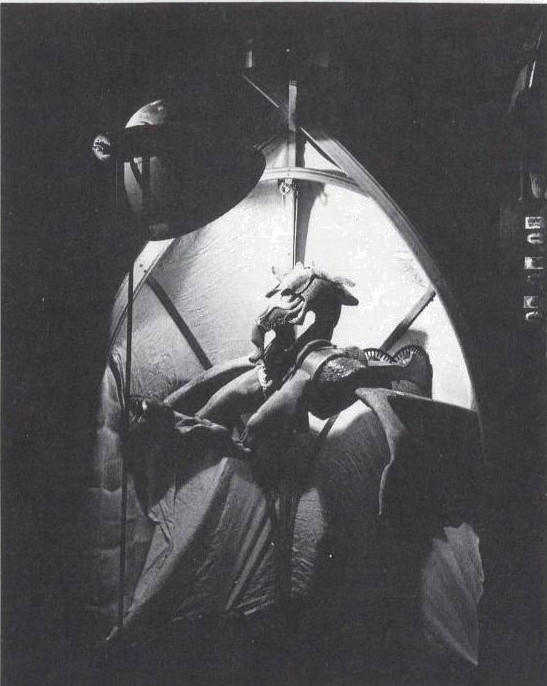
The surrealist supersession of art does not "solve" the problems of human expression, of course; it only provides the basis for their solution. For the very reason that "art" no longer exists, the world all the more urgently needs each and every concrete prefiguration of the advance of liberated desire-everything that prompts us to dream while awake, everything that inspires us to demand more of life. From this viewpoint painting and drawing become magic windows through which we can see what had not been seen. Only through these breaches in the prison walls of "reasonable reality" can the inner eye focus on the becoming of true life.
This explains why, situating themselves unequivocally beyond art, the surrealists have only disdain for the abject hucksters of "anti-art" who so eagerly prostrate themselves before the dominant images of miserabilism. Unable to decide which of their own eyes is blind, these confusionists try to persuade everyone else that there is nothing to see. If art in its "official" mummification is one side of the ruling lie, the other side of that counterfeit coin is antiart as codified by various myopic remnants of the "counterculture" and the "new left."
Detained neither by the senility and death-agony of art nor by the infantile disorders of anti-art, surrealism has remained insistently elsewhere, according to Fourier's principle of absolute divergence. Little concerned by the irrelevant absurdities of "beauty," "line," "form," "composition," etc., the surrealists are preoccupied by more compelling matters: the exteriorization of libido, isolation of obsessive images, determination of the automatic message, and other means of expressing "the real functioning of thought," hastening the conquest of the irrational as a step toward the total transformation of the world.
By placing this exhibition under the sign of MARVELOUS FREEDOM, we have intended to emphasize that surrealism is today the only consistent and thoroughgoing enemy of all miserabilism.
In his essay "Away with Miserabilism!" (1956) Breton announced that the time had come to study clinically this "plague" as there are categories of misery that "permits of as many variations." Tracing it historically as "the offspring of the perfect coupling of those two vermin, Hitlerite fascism and Stalinism," Breton described its essence: "the depreciation of reality in place of its exaltation."
Generalizing from Breton's discussion we may define miserabilism as the rationalization of the unlivable. A product of the epoch of capitalist decline, it is the summation of all ideological excrescences of the "accumulation of misery" that Marx correlated with the accumulation of capital. "Accumulation of wealth at one pole," wrote Marx (in Capital, Vol. I), means "accumulation of misery, agony of toil, slavery, ignorance, brutality, mental degradation at the opposite pole." It is plain that this misery did not signify for Marx a narrowly "economic" category; he remarks on the same page that "in proportion as capital accumulates, the lot of the laborer, be his payment high or low, must grow worse." (Emphasis added, F.R.)
Events of the last decade-from the Detroit Insurrection to the Lordstown Strike (to cite only U.S. examples)-have confirmed that the working class still has nothing in common with the employing class; that between these classes a struggle continues, and will continue till the workers of the world organize as a class, take possession of the earth and the machinery of production, and abolish the wage system.
Only now are we emerging from a prolonged period of counterrevolution: a period starting in the 1920s with the defeat of the German and Chinese Revolutions; continuing through the next decade with the defeat of the Spanish Revolution, the spread of fascism, the Stalinist Thermidor; proceeding through the imperialist war of 1939-45; culminating in the structural assimilation of fascist "innovations" by the victorious "democracies" throughout the Cold War. During that period the autonomous class movement of the proletariat was crushed-its traditions obliterated. The delay in world revolution has been time lost for all revolutionary tendencies and time won for an ever more concentrated ruling class which, drawing on its vast legacy of experiences at ruling, has been quicker to learn its lessons from the class struggles of this century than has the working class. With each defeated uprising of the proletariat the bourgeoisie have refined and developed their methods of social control.
Only the smallest revolutionary minority survived this succession of debacles. The surrealist movement, a small minority within this minority, could not have remained unaffected by the setbacks and defeats of the entire workers' movement. Indeed, whole sections of our movement perished during or shortly after the war. But widely scattered individuals and small nuclei, often reduced to an "underground" existence, continued to defend surrealist perspectives in the most adverse conditions. What is important is that the movement as a whole never lost that limitless revolutionary confidence expressed by Breton in "Limits Not Frontiers of Surrealism" (1936) that "nothing can prevent surrealism from believing that the last glance of the men and women who fell in July 1936 before Saragossa holds within itself the whole future."
If the worst counterrevolution in history could not alter this confidence-if surrealism, alone among international "intellectual" or "cultural" currents-has held out against an almost universal demoralization and backsliding throughout the period of world reaction-it has been because the surrealist practice of poetry permits its adherents to see beyond the immediate disasters, the temporary defeats, to the Golden Age that lies ahead. This materialist conception of poetry-roughly outlined in the works of Lautréamont and Rimbaud, and given its definitive expression in the Manifestoes of Breton-restores poetry to its true revolutionary critical function as the bearer of the unfettered imagination, prefiguring the "leap," signaled by Marx and Engels, "from the realm of necessity to the realm of freedom."
The basic assumption of miserabilism is that misery is eternal—that there is no way out. Beginning with resignation, it passes quickly enough to the outright glorification of misery for misery's sake. This is the function of nearly the whole superstructure of advanced capitalist society today: from religion to the advertising agencies, from the politicians to the false poets. As the quintessential ideological expression of decadent capitalism's surge toward barbarism, reinforced by the universal institutionalization of the death-wish, miserabilism rests on an extreme brutalization of language-a monstrous depreciation of all signs, so that it becomes increasingly impossible for men and women to think; impossible above all to express their thoughts with any coherence, lucidity or ardor. All signs by which communication is supposed to be effected are degraded to the narrowest utilitarian function, made subservient to the fetishism of commodities, and deprived of all brilliance, all fire.
The word "marvelous" today is used to describe the latest fashions in clothes, automobiles, household appliances. There always seems to be someone low enough and mean enough to pronounce this word over even the vilest outrages committed by the vilest people.
"Freedom" today, as the managers of wage slavery cackle over their "bicentennial celebration," is freedom to be stupefied, poisoned, bored-freedom to submit or shut up-freedom of a mere handful of exploitative parasites to squeeze from the great mass of humanity not only surplus value but life itself.
This degradation of language is a function of repression, using the term in both its political and psychological senses. Consciousness is false whenever true desire is unconscious. The first task of those who would change life is to bring unconscious desires to consciousness. This requires nothing less than the liberation of language, and of all signs, from the stifling grip of the miserabilist mystifiers for whom these signs exist only as instruments of bureaucratic manipulation. Surrealist intervention-in poetry, plastic arts, psychology, anthropology, linguistics, politics, everyday life-starts by reducing and aims at resolving the paralyzing antinomies between imagination and reason, dream and action, unconscious and conscious. By following through the implications of this disalienating revolutionary poetic praxis, each person may discover for himself the truth of Breton's remark that "language was given to man to make surrealist use of it."
Nothing less than the utmost VIGILANCE OF DESIRE, carried to its furthest excesses, can restore a human meaning, a living actuality, to the words "marvelous" and "freedom" which have suffered so much for so long at the hands of those who are the worst enemies of all that these words truly stand for. This surrealist vigilance, dialectically resolving the contradiction between utopian reverie and scientific concentration, constitutes an affective medium in which revolutionary and poetic thought and action can develop with best results.
The undesirable, the unlivable, the miserable can be vanquished only when the desirable is concretely determined. It is with this view that surrealism mobilizes its concretizations of the Marvelous against all miserabilist abstractions and institutions. An exhibition would hold no interest if it were not designed to demystify and discredit-and help destroy-the decrepit but debasing lies that enable oppressive obscurantists to stay in power. An endless succession of magic windows looking out on that which will be, the World Surrealist Exhibition is also necessarily a defenestration of falsehoods, platitudes and apologies for the existing order.
Among the first to be defenestrated will be the ideologies and ideologists of the pseudo-Marvelous and the hypocritical "freedom" that exists only for the bourgeoisie and their bureaucrats. A dying social order prolongs its life by accentuating its plunder of the living. Only by giving itself transfusions from the works of Marx and Freud has the basically death-oriented culture of the imperialist epoch maintained a semblance of intellectual vitality. More recently it is surrealism that has been subjected to such abuse. This does not mean what a few shortsighted critics pretend, that surrealism has been "integrated" into the ruling culture. Rather it means that surrealism-and all revolutionary thought-must be continually and integrally restored in opposition to all eclectics, opportunists and recuperaters, and that it must be ever more rigorously applied and developed. Those who have expropriated the Marvelous for repressive ends will themselves be marvelously expropriated. Surrealism, the executive agency of the poetic imagination, will see to it that everything that rightfully belongs to poetry is restored to it—that is, the whole world.
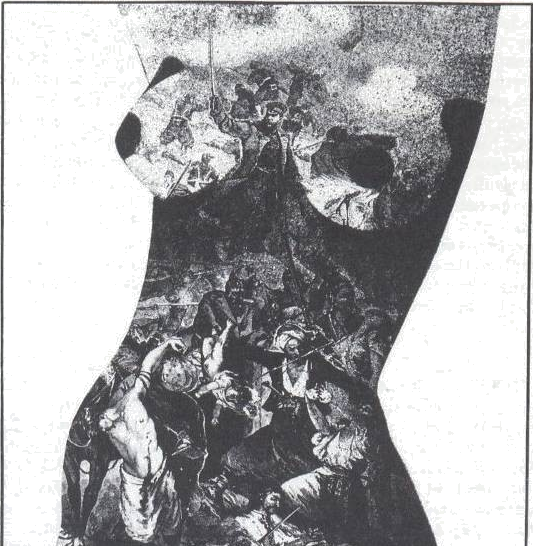
The World Surrealist Exhibition opens its doors to the public after more than a year and a half of planning by the Surrealist Movement in the U.S., in closest collaboration with groups and individuals in many countries. The purpose of this extensive discussion was to define, as precisely as possible, the specificity of this exhibition, and-more importantly-the specificity of surrealist intervention today on the planetary scale. Nothing was further from our intention than merely to send out invitations indiscriminately to everyone who may happen to call himself a surrealist. We were determined, rather, to attain maximum theoretical and programmatic clarity, to establish the exhibition on a principled basis. This required the categorical exclusion of a whole crowd of impostors and opportunists, to say nothing of renegades who, feigning repentance on bended knees, would like us now to forget what rats they were and are.
Nothing short of this rigorous policy-derived from revolutionary poetic aims and principles that are invariable and beyond argument-could assure the continuity and extension of surrealism today as a "lever" (to use Breton's expression) of human emancipation. This vigilance, always and everywhere indispensable in poetic as in revolutionary matters, is especially urgent in the present historical conditions, because this exhibition is intended not to "commemorate" an already evolved period, and certainly not as an end in itself, but rather as a major step toward reconstruction of the surrealist international-as an advance that in turn will stimulate other advances in the same direction.
The surrealists' passionate commitment to principles does not mean that surrealism is a finished system, petrified like a church, doomed by dogma to endless self-repetition. On the contrary, it is those who most noisily turn their backs on principles who are finished, petrified, doomed to re-enact the same old mistakes again and again.
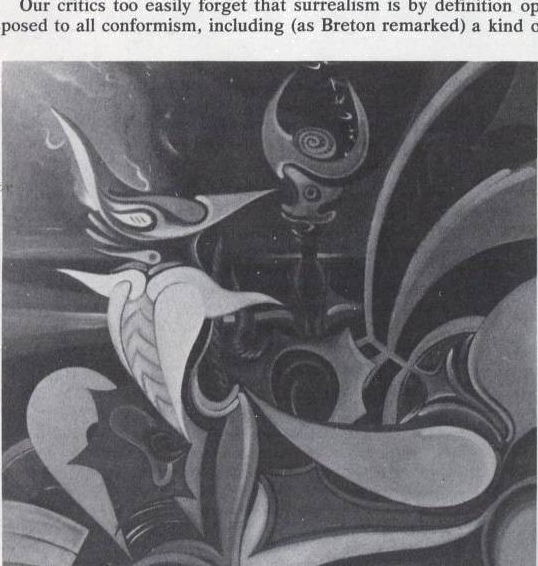
Our critics too easily forget that surrealism is by definition opposed to all conformism, including (as Breton remarked) a kind of "surrealist" conformism evidenced by numerous imitators of surrealist painting and poetry. In art as elsewhere, Breton insisted, each person must "set out on his own search for the Golden Fleece"; the only "great expeditions" are those that are undertaken "at the risk of one's life.
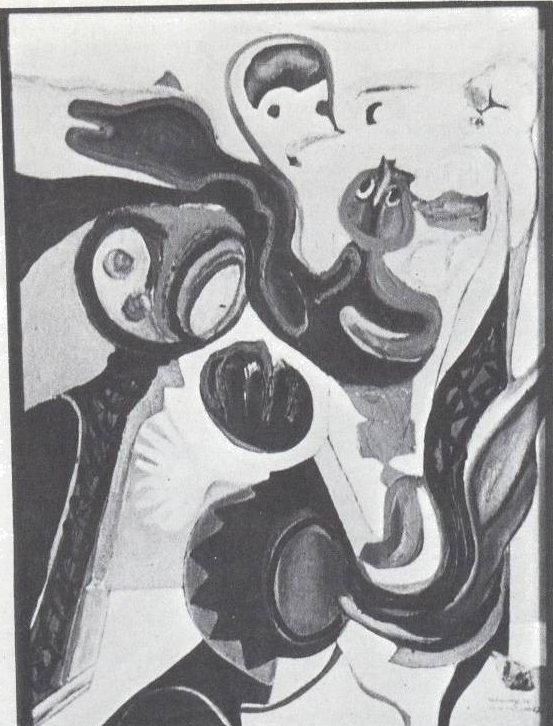
Every effort has been made to exclude from this exhibition, and from surrealist activity as a whole, anyone who has failed to assume this risk. It is false to speak of surrealism as a "style" or "school" of art or of anything else. Surrealism is the Garden of Eden restored beyond Good and Evil. On the tree of liberty, no two leaves are alike. The marvelous diversity of surrealism is at once the surest measure and the guarantee of its vigilant unity as a project of total revolution.
Against the traumatic as well as the trivial myths of today's slaveholders and slaves-against the repressive and reactionary myths of God, Country, Flag, Family, Money, Work-the surrealists of all countries uphold the only myth that is "absolutely modern" as well as "older than time." This myth, revolutionary, liberatory, exalting-and therefore fundamentally different from all other myths rises from the ashes of the old order, from all the old orders, to announce a new life, a surrealist life.
Confirming the destiny of caprices, verifying the implications of dreams, pursuing the revelations of chance, preparing the dictatorship of the imagination and heralding the triumph of mad love—surrealism follows through each and every glimmering hint that allows us to redefine the everyday labyrinth in terms of moments that are defiantly magnetic-moments that are the very apples of the Great Invisibles' eyes.
It is to provide a tentative initiation into the becoming of this new myth that we have organized the World Surrealist Exhibition. Caring little for didactic "insights," we have preferred to present incitements to dream and to act-incitements to live the new life in which marvelous freedom will be realized by all.