Domains of Surrealist Vigilance
T-Bone Slim
REVOLT OF THE SHADOWST-BONE SLIM
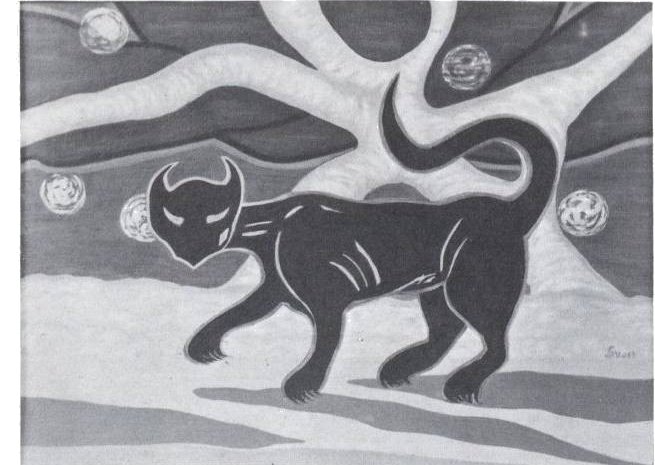
Ever since the black cat of repressed desire crossed the path of civilization, the only lucky winners in the "great game" have been those who have had nothing to lose, and who, moreover, have broken all the rules.
Although his satirical songs "The Popular Wobbly," "The Mysteries of a Hobo's Life," and "I'm Too Old to be a Scab" are among the best-loved lyrics in The Little Red Songbook of the Industrial Workers of the World (IWW), little is known about their author, the elusive figure known to the world as T-Bone Slim. The lack of information is all the more striking because, as Fred Thompson notes in The IWW: Its First Fifty Years, T-Bone Slim was the IWW's "most noted columnist."
His contributions to IWW publications, spanning twenty-four years, would fill a large book. And an extraordinary book it would be too, for T-Bone's writing has a unique flair, a deep humor, and a sharp awareness of the poetic essence of language. These are the characteristics that make his pamphlet Starving Amidst Too Much (a critique of the food-packing industry) perhaps the greatest work by an IWW writer.

The gaps in the story of T-Bone Slim are larger than the story itself. Fred Thompson tells us that T-Bone's real name was Matt Valentine Huhta, that he was an Ashtabula (Ohio) Finn, and that he died in October 1942, drowning while working as a barge captain in New York. Another IWW old-timer, Carl Keller, recalls that for T-Bone the customary proletarian mistrust and dislike of capitalists, cops and priests took on a personal intensity-that he had something of a "persecution complex," especially during sojourns in the cities; he was, by contrast, completely at ease riding freights through the open countryside.
I laugh, in tears, and hope without a hope;
I take comfort in harsh despair;
I rejoice, and have no pleasure;
I am strong, without strength or power;
Eagerly welcomed, and rebuffed by all.
— François Villon
T-Bone Slim lived always in the shadows, always on the move. Visiting one day at the IWW Work People's College in Duluth, a few days later he might drop by a hobo jungle outside Chicago, next day at a flophouse in Detroit, the following week on the Bowery in New York and two months later on Seattle's Skid Road.
You wandered across the verbal sand
tying red ribbons to oblivion
You rewrote the script of darkness to
throw at the dismal light of day
— Franklin Rosemont ("Homage to T-Bone Slim")
A "missionary," he belonged to that tribe of "moralists who roamed the villages starving," invoked by Lautréamont. But the morality he preached and practiced was the revolutionary morality of class war, of the abolition of wage slavery. To this struggle he brought a defiant and restless poetry, committed to paper (as Fred Thompson relates) "as the ideas struck him, with no particular sequence." Faithful always to his dreams and to the dreams of his class, T-Bone Slim left his disquieting laughter etched forever in the haunted mirrors of modern mythology.